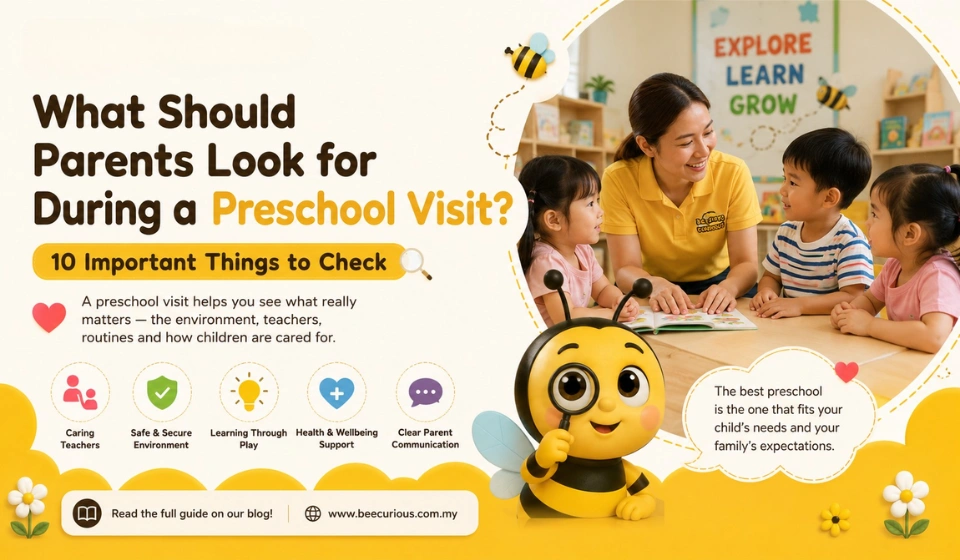
What Should Parents Look for During a Preschool Visit? 10 Important Things to Check

Choosing a preschool is a big decision for parents. You may spend time comparing programmes, locations, fees, facilities and activities—but one of the most useful steps is often a simple one: Visit the Preschool.
A preschool visit allows you to see beyond a website or brochure. You can observe the environment, notice how teachers interact with children and ask questions about your child’s daily experience.
For parents of children aged 2–6, these details can make a real difference when comparing preschool options.
But what exactly should you look for?
Here are 10 important things to check during a preschool visit.
1. How Do Teachers Interact With Children?
Teachers are an important part of your child’s preschool experience.
During your visit, don’t only listen to what the preschool says about its teachers. Watch how they interact with the children.
Do they speak calmly and respectfully? Do they listen when children are talking? Do children appear comfortable approaching them?
You can also notice whether teachers encourage children to participate, explore and try things for themselves.
Ask yourself:
- Do teachers appear warm and approachable?
- Do they pay attention to individual children?
- Do they listen to children’s questions?
- How do they respond when a child needs help?
- Do children seem comfortable around them?
You don’t need to expect every interaction to look perfect. Instead, look for an environment where children appear to be treated with patience, care and respect.
2. Does the Learning Environment Encourage Curiosity?
Young children naturally want to explore the world around them.
During your preschool visit, look at the classroom from a child’s perspective.
Are there opportunities to explore, create, ask questions and discover things? Are learning materials easy for children to see and interact with?
A learning environment does not have to be complicated to be meaningful.
Look for spaces and activities that encourage children to:
- Explore new ideas
- Ask questions
- Make choices
- Create and experiment
- Learn through hands-on experiences
You can also ask how play is incorporated into the children’s learning.
The goal is not simply to ask, “What will my child learn?”
Also ask:
“How will my child be encouraged to learn?”
3. Is the Preschool Environment Safe and Secure?
Safety should be one of the first things parents consider during a preschool visit.
Take a look around the preschool and ask how children are supervised throughout the day.
You can ask about:
- Arrival and pick-up procedures
- Visitor access
- Child supervision
- Emergency procedures
- Security measures
- How the preschool handles accidents or unexpected situations
Don’t hesitate to ask specific questions if something is important to your family.
A safe preschool environment is not simply about having safety equipment. It is also about having clear procedures and responsible supervision.
As a parent, you should leave the visit with a better understanding of how the preschool works to keep children safe during their daily activities.
4. Are the Facilities Suitable for Young Children?
When visiting a preschool, it can be tempting to focus on how new, large or impressive the facilities look.
Instead, think about whether they are suitable for your child’s age and needs.
Look at the classroom, learning areas, play spaces, toilets and other areas your child may use during the day.
Ask:
- Are the spaces comfortable for young children?
- Can children move around easily?
- Are learning materials appropriate for their age?
- Are the toilets child-friendly?
- Are there spaces for different types of activities?
The most important question is not:
“Does the preschool have impressive facilities?”
It is:
“Will these facilities support my child’s everyday learning and development?”
5. What Does a Typical Day Look Like?
A preschool visit is a good opportunity to ask about your child’s daily routine.
Ask the teacher or school representative to explain what a typical day looks like from arrival until pick-up.
For example:
- What happens when children arrive?
- When do learning activities take place?
- When do children play?
- How are meals or snacks managed?
- Are there quiet periods?
- How do children move from one activity to another?
A clear understanding of the daily routine can help you decide whether it matches your child’s needs.
It can also help you prepare your child before they start preschool.
Remember, preschool is not just about completing activities. A child’s day includes opportunities to learn, play, interact, explore and gradually become more comfortable with routines.
6. How Does the Preschool Support Independence?
Children gradually develop independence as they grow.
Preschool can provide everyday opportunities for children to practise simple skills and take responsibility for age-appropriate tasks.
During your visit, ask how children are encouraged to do things for themselves.
For example:
- Can children manage some of their belongings?
- Are they encouraged to tidy up after activities?
- Can they make simple choices?
- Are they given opportunities to try before receiving help?
- How do teachers support children who are still learning?
Supporting independence does not mean expecting young children to manage everything on their own.
It means giving them appropriate opportunities to try, practise and build confidence, while knowing that a teacher is there to support them when needed.
These small experiences can become meaningful parts of a child’s early learning journey.
7. How Does the Preschool Support Social and Emotional Development?
Preschool is also a place where children learn how to interact with others.
They may be learning to make friends, share, take turns, communicate their feelings and handle disagreements.
During your visit, ask how teachers support children’s social and emotional development.
You could ask:
- How do teachers help children make friends?
- What happens when children have disagreements?
- How are children supported when they feel upset?
- How do teachers encourage children to express their feelings?
- How are shy or hesitant children encouraged to participate?
It is also useful to observe the children.
Do they have opportunities to interact with one another?
A preschool should recognise that a child’s development involves more than academic learning. Confidence, communication, relationships and emotional development are also important parts of the early years.
8. What Health and Wellbeing Support Is Available?
Young children may become tired, uncomfortable or unwell during the day.
Parents should therefore understand what support is available if a child needs attention.
During your visit, ask about the preschool’s approach to:
- Children who become unwell
- Minor injuries
- Health concerns
- Emergency situations
- Rest and comfort
- Communicating health concerns to parents
If your child has specific needs, this is also the right time to explain them and ask how the preschool would support your child.
You don’t need to be afraid of asking detailed questions about wellbeing.
In fact, asking these questions can help you understand whether the preschool’s approach matches your family’s expectations.
9. How Does the Preschool Communicate With Parents?
Choosing a preschool is not only about your child’s experience. It is also about the relationship between the preschool and your family.
Ask how parents receive important information and updates.
For example:
- How are parents contacted?
- How are daily updates shared?
- How are concerns communicated?
- How can parents ask questions?
- How are parents informed about their child’s progress?
Good communication should be clear and respectful.
You should feel comfortable asking questions and discussing concerns about your child.
At the same time, the preschool should have a clear way of sharing important information with you.
Before choosing a preschool, make sure you understand how communication will work once your child starts.
10. Does the Preschool Feel Right for Your Child?
After checking everything from safety to facilities, take a moment to think about your child.
Every child is different.
Your child may be outgoing, quiet, highly active, curious, cautious or somewhere in between. Their interests and personality can influence what type of environment helps them feel comfortable.
During the visit, ask yourself:
“Can I imagine my child feeling comfortable here?”
Think about:
- Their personality
- Their interests
- Their current development
- How they respond to new environments
- The type of support they may need
You don’t need to find a preschool that is perfect in every possible way.
You need to find one that feels like a good fit for your child and your family.
A Simple Preschool Visit Checklist
If you are visiting several preschools, take this checklist with you:
| What to Check | What to Observe |
|---|---|
| Teachers | How do teachers speak and respond to children? |
| Learning Environment | Does it encourage curiosity and exploration? |
| Safety | Are there clear safety and security procedures? |
| Facilities | Are they suitable for young children? |
| Daily Routine | Is the day structured around different learning and activity experiences? |
| Independence | Are children encouraged to try things for themselves? |
| Social & Emotional Development | How are friendships and emotions supported? |
| Health & Wellbeing | What happens when a child needs health or wellbeing support? |
| Parent Communication | How will parents receive information and updates? |
| Overall Fit | Does the environment feel right for your child? |
Questions Parents Can Ask During a Preschool Visit
Sometimes parents know they want to ask questions but aren’t sure where to begin.
Here are some useful questions to take with you:
- What does a typical day look like for children?
- How do teachers support children’s individual needs?
- How is play included in children’s learning?
- How do teachers support children’s social and emotional development?
- What safety and security procedures are in place?
- What happens if my child becomes unwell?
- How do you encourage children to become more independent?
- How do you communicate with parents?
- How can parents discuss concerns about their child?
- Can I see the spaces where my child will learn and play?
You don’t need to ask every question exactly as written. Use them as a starting point for a meaningful conversation with the preschool team.
Don’t Just Look. Observe.
A preschool visit is more than a tour of classrooms and facilities.
It is an opportunity to look, listen and observe.
Notice how adults speak to children.
Notice whether children seem comfortable.
Notice whether the environment encourages exploration.
Notice whether you feel welcomed when asking questions.
Most importantly, think about your own child.
Would they feel comfortable here?
Would they have opportunities to explore and learn?
Would they receive the support they need?
These observations can help you move beyond simply comparing preschools based on brochures or feature lists.
The “Best” Preschool Is the Right Fit
There is no single preschool that will be the perfect choice for every family.
What matters is finding an environment that matches your child’s needs and your family’s expectations.
That means looking beyond the number of activities, the appearance of the building or a long list of features.
Look at the people.
Look at the environment.
Ask questions.
Observe the children.
Think about your child.
A preschool visit can give you valuable insight into what your child’s everyday experience could look like.
And sometimes, the best decision comes from simply asking yourself:
“Can I see my child learning, growing and feeling comfortable here?”
Visit Bee Curious Preschool
If you’re exploring preschool options for your child, a school visit can help you understand the environment, ask your questions and decide what feels right for your family.
🐝 Bee Curious Preschool – Putra Perdana
📞 WhatsApp: +60 18 202 4369
🌐 www.beecurious.com.my
Book a school tour and discover the Bee Curious experience for yourself.