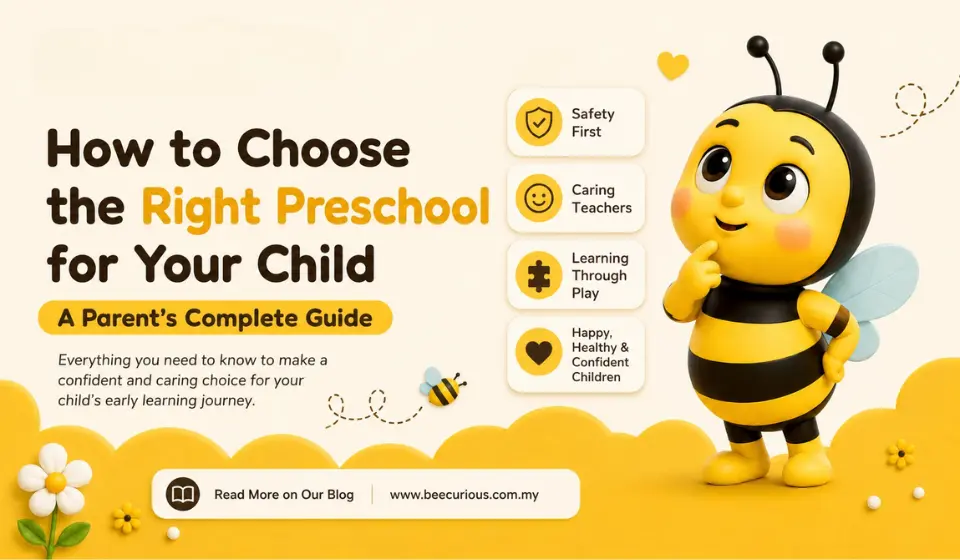
How to Choose the Right Preschool for Your Child: A Parent’s Complete Guide

Choosing a preschool is an important decision for any parent. For children aged 2–6, preschool is often one of their first experiences in a structured learning environment outside the home.
With so many options available, it can be difficult to know what really matters. Should you focus on the curriculum, location, fees, facilities or teachers?
The answer is: look at the whole picture—and most importantly, think about what your child needs.
A good preschool should provide more than academic activities. It should offer an environment where children can feel safe, build relationships, explore through play, develop independence and gradually grow in confidence.
Here are 10 important things to consider when choosing a preschool for your child.
1. Start With Your Child’s Needs
Every child is different.
Some children are naturally outgoing, while others take more time to feel comfortable in a new environment. Some enjoy drawing and stories, while others learn by building, moving and exploring.
Before comparing preschools, think about your child’s:
- Personality and temperament
- Age and developmental stage
- Interests and strengths
- Social comfort
- Independence
- Learning preferences
Instead of asking, “Which preschool is the best?”, ask:
“Which preschool is a good fit for my child?”
This simple change in perspective can make the decision much clearer.
2. Understand the Preschool’s Learning Approach
Not all preschools approach learning in the same way.
Ask how children spend their day and how learning takes place. Are they given opportunities to play, explore, create, ask questions and solve simple problems?
Learning through play can support children’s development in many areas, including communication, creativity, collaboration and problem-solving.
At Bee Curious Preschool, the learning approach is child-led, inclusive and play-based, with opportunities for creative expression, communication, collaboration, problem-solving and exploration.
The important thing is to understand what children actually experience each day, rather than choosing a preschool based only on a programme name.
3. Look at the Teachers, Not Just the Programme
A programme may look impressive on paper, but children experience preschool through their relationships with teachers.
During your research or school visit, notice how teachers speak and respond to children.
Ask yourself:
- Are teachers patient and approachable?
- Do they listen to children?
- Do children seem comfortable asking for help?
- Are teachers encouraging children to try things independently?
- Do teachers recognise individual differences?
Warm, caring relationships can help children feel more comfortable as they adjust to preschool and participate in learning.
Bee Curious highlights caring teachers who guide children with patience, warmth and passion.
4. Check the Environment and Facilities
A preschool environment should be suitable for young children—not simply attractive to adults.
Look for spaces that are:
- Clean and organised
- Safe and child-friendly
- Comfortable
- Age-appropriate
- Suitable for both active and quieter activities
You can also look at whether children have opportunities for reading, creative activities, indoor play and exploration.
Bee Curious’s facilities include reading corners, indoor play areas and child-friendly washrooms.
During a visit, don’t just look at how the preschool looks. Ask yourself:
“Can I imagine my child learning and playing comfortably here?”
5. Make Safety a Priority
Safety should always be part of your preschool checklist.
Ask about:
- How children enter and leave the school
- Supervision during activities and play
- Visitor procedures
- Emergency arrangements
- Security monitoring
- How the school communicates with parents about safety concerns
Bee Curious’s school information highlights secure check-in systems and CCTV monitoring as part of its safety and security measures.
Don’t be afraid to ask detailed questions. A preschool should be able to explain its safety practices clearly.
6. Think About Your Child’s Health and Wellbeing
Young children need more than a learning programme. Their physical and emotional wellbeing matters throughout the school day.
Parents can ask:
- What happens if my child becomes unwell?
- How are hygiene routines handled?
- How are parents informed about health concerns?
- What support is available if a child needs medical attention?
Bee Curious highlights on-site medical care through the SV Care Clinic located next door, which can provide additional reassurance for families.
Understanding these arrangements before enrolment can help parents feel more prepared.
7. Find Out How the Preschool Supports Social and Emotional Development
Preschool is also a time when children begin developing important social and emotional skills.
They learn to:
- Make friends
- Take turns
- Communicate
- Cooperate
- Express feelings
- Develop confidence
- Become more independent
Ask how teachers respond when children disagree, feel upset or find it difficult to join an activity.
Bee Curious’s programme highlights areas such as confidence, empathy, independence, emotional intelligence and social responsibility.
These skills are an important part of a child’s overall early development.
8. Understand the Daily Routine
Before enrolling, find out what a typical day looks like.
Ask about:
Arrival → Learning → Play → Meals → Activities → Indoor/Outdoor Play → Quiet Time → Pick-Up
A daily routine gives children opportunities to know what to expect while allowing time for different types of learning and activity.
It can also help parents understand whether the preschool’s schedule fits their child’s needs and their family’s routine.
9. Consider Practical Needs for Your Family
Even a preschool that looks excellent may not be practical for your family.
Consider:
- Location
- Operating hours
- Transportation
- Pick-up arrangements
- School calendar
- Communication methods
- Fees
- Additional charges
For working parents especially, practical arrangements can make a significant difference to the family’s daily routine.
Bee Curious also provides transportation as an additional service, which parents can discuss with the school based on their location and requirements.
10. Visit the Preschool Before Deciding
A website or brochure can give you useful information, but nothing replaces seeing the environment for yourself.
During a school visit, observe:
- How teachers interact with children
- How children behave in the classroom
- Whether children seem engaged
- The condition of the facilities
- How activities are conducted
- How the school communicates with parents
Most importantly, bring your child along if possible.
Watch their reaction.
Do they appear curious? Comfortable? Interested in exploring?
Sometimes, your child’s response can tell you something that a brochure cannot.
Preschool Comparison Checklist
When comparing different preschools, use this simple checklist:
| What to Consider | Questions to Ask |
|---|---|
| Learning | How do children learn each day? |
| Teachers | How do teachers interact with children? |
| Safety | How are children supervised and protected? |
| Environment | Is the space welcoming and child-friendly? |
| Development | Are social and emotional skills supported? |
| Health | What happens if my child becomes unwell? |
| Routine | What does a typical day look like? |
| Communication | How are parents kept informed? |
| Practical Needs | Do the hours, location and transport work for us? |
| Child Fit | Does my child seem comfortable here? |
6 Common Mistakes to Avoid When Choosing a Preschool
1. Choosing Based Only on Price
Fees are important, but they should be considered alongside the learning environment, care, facilities and overall fit.
2. Focusing Only on Academics
Preschool development goes beyond letters and numbers. Social, emotional, communication and independence skills matter too.
3. Choosing Based Only on Facilities
A beautiful classroom is valuable, but caring teacher-child relationships are equally important.
4. Not Visiting the School
Try to experience the environment before making your decision.
5. Comparing Your Child With Other Children
Children develop at different rates. Focus on whether the preschool supports your child’s individual journey.
6. Not Asking Questions
There is no such thing as an unimportant question when it concerns your child’s wellbeing and education.
10 Questions Every Parent Should Ask
Before making your final decision, consider asking:
- What learning approach do you follow?
- What does a typical day look like?
- How do teachers support individual children?
- How do you help children settle into preschool?
- What safety procedures are in place?
- What happens if my child becomes unwell?
- How do you support social and emotional development?
- How do you communicate with parents?
- What are the total fees and additional charges?
- What transportation options are available?
How Do You Know a Preschool Is a Good Fit?
There may not be one perfect preschool for every child.
The right preschool is one where your child can feel safe, supported and comfortable while having opportunities to play, explore, learn and grow.
Before making your decision, ask yourself:
☐ Does my child seem comfortable?
☐ Do teachers interact warmly with children?
☐ Does the learning approach suit my child?
☐ Does the environment feel safe and welcoming?
☐ Are there opportunities for play and exploration?
☐ Will my child be encouraged to develop independence?
☐ Can I communicate comfortably with the school?
☐ Does the preschool fit our family’s practical needs?
If most of these answers are yes, you may have found an environment worth considering.
Conclusion: Choose With Your Child in Mind
Choosing a preschool is a big decision, but it doesn’t have to be overwhelming.
Start by understanding your child’s needs. Look beyond academics and consider the teachers, learning approach, safety, environment, health support, social development and practical needs of your family.
Most importantly, visit the preschool and experience it for yourself.
The right environment can give children the confidence to explore, build relationships, develop independence and discover the joy of learning.
If you’re exploring preschool options for your child, come and visit Bee Curious Preschool in Putra Perdana. We’d be happy to show you our learning environment and help you understand how we support young children through their early learning journey.
🐝 Book a school tour today.
📍 Bee Curious Preschool – Putra Perdana
📞 WhatsApp: +60 18 202 4369
🌐 Visit Bee Curious Preschool
🚐 Transportation available (additional charges).