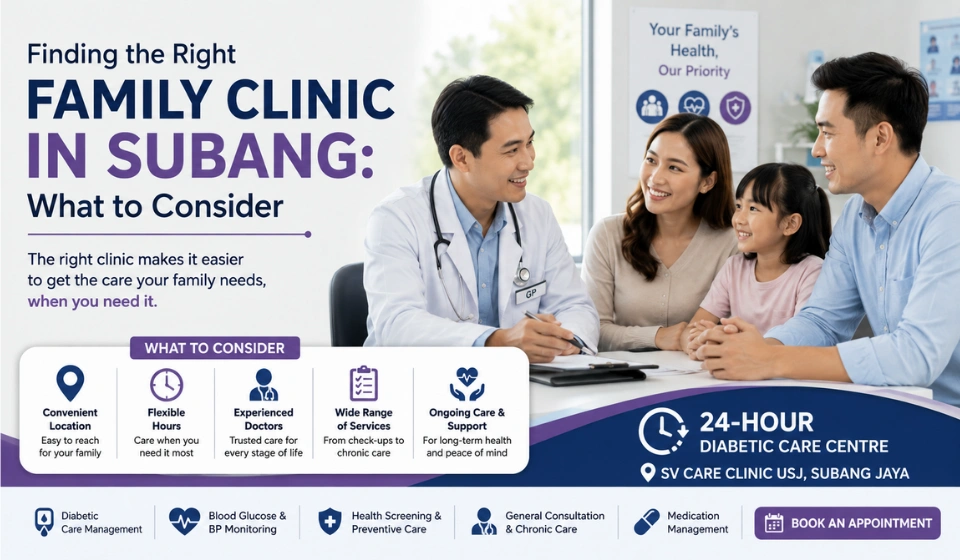

Family Clinic Subang: What Should You Consider?
When you need medical care for yourself or an older family member, choosing a clinic can feel surprisingly difficult. Should you look for a clinic close to home? A doctor who can manage ongoing health conditions? A clinic that offers health screening? Or one that is open when you actually need it?
If you are searching for a family clinic in Subang, the right choice depends on your family’s needs rather than simply choosing the nearest clinic.
A good family healthcare option should make it easier to get appropriate medical advice, manage ongoing health concerns and access preventive care when needed.
Quick Answer
When choosing a family clinic in Subang, consider the clinic’s location, operating hours, doctors, services, experience with ongoing health conditions, diagnostic facilities and how easily you can arrange an appointment.
For families with older adults or people living with conditions such as diabetes or hypertension, it can also be useful to choose a clinic that supports ongoing monitoring rather than only treating occasional illnesses.
What Is a Family Clinic?
A family clinic is generally a primary-care setting where people can seek medical advice for a wide range of everyday and ongoing health concerns.
Unlike a service that focuses on only one medical problem, primary care can cover different needs over time.
Depending on the clinic, services may include:
- General medical consultations
- Health screening
- Blood glucose monitoring
- Blood pressure monitoring
- Preventive healthcare
- Vaccination
- Minor medical care
- Chronic disease management
- Women’s health services
- Children’s healthcare
- Diagnostic tests
- Medication-related support
The exact services vary from one clinic to another, so it is worth checking what is available before making an appointment.
Why Does Choosing the Right Clinic Matter?
A clinic may become part of your family’s healthcare routine, particularly when someone needs regular monitoring or has a long-term health condition.
For example, an older adult with diabetes may need more than an occasional consultation. Their healthcare may involve regular monitoring, lifestyle discussions, medication reviews and assessment of other health risks.
Similarly, someone who is generally healthy may primarily need preventive care, vaccinations or periodic health screening.
Choosing a clinic that matches these needs can make healthcare more convenient and consistent.
What Should You Consider When Choosing a Family Clinic in Subang?
There is no single “best” family clinic for everyone. Instead, consider what matters most to you and your family.
1. Is the clinic conveniently located?
Location matters, especially if you expect to visit the clinic regularly.
A clinic that is reasonably close to your home, workplace or another frequently visited area may make it easier to attend appointments and follow up when necessary.
For older adults or people with mobility difficulties, accessibility can be particularly important.
2. What are the clinic’s operating hours?
A clinic’s opening hours can make a significant difference when someone becomes unwell outside normal working hours.
Before choosing a medical clinic in Subang, check:
- Opening and closing times
- Whether the clinic operates on weekends
- Whether appointments are required
- Whether walk-ins are accepted
- How to contact the clinic after hours
If you have a condition that may require regular or urgent medical attention, extended operating hours can be especially useful.
3. What type of doctor is available?
Look at the doctors’ qualifications and areas of practice.
A general practitioner can assess many common health concerns, while some doctors may have additional experience in areas such as:
- Family medicine
- Chronic disease management
- Diabetes care
- Women’s health
- Wound care
- Preventive healthcare
- Primary and emergency care
If you are choosing a family doctor in Subang, consider whether the doctor’s experience matches the needs of your household.
4. Does the clinic provide preventive healthcare?
Healthcare is not only about treating symptoms after they appear.
Depending on your age and individual risk factors, preventive care may include health assessments, blood tests, vaccination and screening.
A clinic that provides preventive services can make it easier to discuss your health before a concern becomes more complicated.
However, not everyone needs the same tests or screening schedule. A doctor can help determine what is appropriate based on your age, medical history and risk factors.
5. Can the clinic support long-term health conditions?
This can be an important consideration for families caring for older adults.
Conditions such as diabetes and high blood pressure often require ongoing monitoring rather than a single consultation.
You may want to ask whether the clinic provides services such as:
- Blood glucose monitoring
- Blood pressure monitoring
- Medication management
- Regular consultations
- Health screening
- Lifestyle and preventive guidance
- Chronic disease follow-up
Having these services available in one place may make ongoing care more manageable.
6. Are diagnostic services available?
Sometimes a doctor may need additional information to understand a health concern.
Depending on the clinic, diagnostic support may include:
- Blood tests
- Urine tests
- Rapid tests
- X-rays
- Ultrasound
- Other appropriate investigations
Having access to relevant diagnostic services can make the healthcare process more convenient, although the need for any particular test depends on the individual situation.
SV Care’s wider healthcare service network, for example, includes consultation, blood tests, X-ray, ultrasound, health screening, vaccination and preventive care.
7. Can the clinic support elderly family members?
Older adults may have several healthcare needs at the same time.
When choosing a family healthcare clinic in Subang, consider whether the clinic can support concerns such as:
- Diabetes
- High blood pressure
- Heart health
- Medication management
- Mobility-related concerns
- Wound care
- Regular health monitoring
For people who have difficulty travelling, home healthcare may also be worth considering. Homecare services can include doctor home visits, health screening, medical check-ups, diabetic care and hypertension or cardiac monitoring.
Common Questions About Choosing a Family Clinic
Should I choose a clinic based only on location?
Not necessarily.
Convenience is important, but it should be considered alongside the clinic’s services, doctors, operating hours and ability to support your healthcare needs.
A clinic that is slightly farther away but better suited to your family’s needs may be more practical in the long run.
Is a GP clinic suitable for older adults?
A general practitioner can provide primary medical care for many common concerns and help assess whether further investigation or specialist care is needed.
For older adults with multiple ongoing conditions, it can be helpful to choose a clinic that provides appropriate chronic disease monitoring and follow-up.
What should I bring to my first appointment?
If possible, bring:
- Identification and relevant medical records
- A list of current medications
- Information about known allergies
- Recent test results
- Home blood pressure or blood sugar readings, if relevant
- A brief record of your current symptoms
This can help the doctor understand your situation more clearly.
Should I book an appointment or walk in?
This depends on the clinic.
Some clinics accept walk-ins, while others may recommend appointments for certain services. Checking beforehand can save time, particularly if you need health screening or another specific service.
When should I look for a different clinic?
You may want to reconsider your healthcare arrangement if:
- The clinic does not offer services you regularly need
- The operating hours are difficult for your schedule
- You have difficulty arranging follow-up care
- Your healthcare needs have changed
- You need ongoing monitoring that the clinic cannot provide
- You are not clear about how to access further care when needed
The goal is not to find a clinic that offers everything. It is to find one that is appropriate for your actual healthcare needs.
When Should You Speak With a Doctor?
Choosing a clinic is only part of looking after your health. Knowing when to seek medical advice is equally important.
Consider speaking with a doctor if you have:
- Symptoms that persist or keep returning
- Unexplained changes in your health
- Ongoing fatigue or weakness
- Repeated dizziness
- Changes in appetite or weight
- Persistent digestive symptoms
- Concerns about blood pressure or blood sugar
- A long-term health condition that is becoming difficult to manage
- A new symptom that concerns you
You do not need to know what is causing the problem before making an appointment.
A doctor can assess your symptoms, medical history and risk factors and advise what should happen next.
If symptoms are severe or potentially life-threatening, seek emergency medical care rather than waiting for a routine clinic consultation.
What Can You Do Before Choosing a Clinic?
A simple comparison can help.
Make a short checklist
Ask yourself:
Location:
Is it convenient for me and my family?
Hours:
Can we access care when we are likely to need it?
Doctors:
Do the available doctors have suitable primary-care experience?
Services:
Does the clinic offer the consultations, screening or monitoring we may need?
Ongoing care:
Can the clinic support long-term health conditions?
Diagnostics:
Are relevant tests available or accessible when required?
Accessibility:
Is the clinic suitable for older family members or people with mobility difficulties?
Appointments:
Is it easy to book and follow up?
This approach can be more useful than simply searching for the clinic with the highest number of services.
Finding Healthcare Services in Subang
For people living around Subang and Subang Jaya, healthcare needs can range from occasional general consultations to ongoing chronic disease management.
If diabetes is an important concern for your family, it may be useful to consider a clinic with dedicated diabetic support.
Qualitas SV Care Clinic USJ is positioned as a 24-hour diabetic care centre in USJ, with a focus on diabetes management and long-term health management. Its services include diabetic care management, blood glucose monitoring, health screening, preventive care, consultation, medication management, and hypertension and cardiac monitoring.
The clinic also has general practitioners and provides continuous medical support, making it particularly relevant for people looking for accessible primary care alongside chronic disease monitoring.
A Family Clinic Should Fit Your Needs
The “right” family clinic is not necessarily the biggest clinic, the closest clinic or the one with the longest list of services.
It should be a healthcare option that fits your family’s practical needs.
For some people, that may mean convenient general consultations. For others, it may mean preventive health screening. If an older family member has diabetes or hypertension, ongoing monitoring and continuity of care may be more important.
Before choosing a family clinic in Subang, look beyond the clinic name and consider the doctors, services, accessibility, opening hours and type of ongoing support available.
That way, you can make a healthcare decision based on what your family actually needs.
FAQ
1. How do I choose the best family clinic in Subang?
Consider location, opening hours, doctors, available services, diagnostic support, preventive care and the clinic’s ability to manage your family’s ongoing healthcare needs.
2. What services should a family clinic provide?
Depending on your needs, useful primary-care services may include general consultations, health screening, vaccination, preventive care, chronic disease monitoring and appropriate diagnostic testing.
3. Should I choose a clinic that is open 24 hours?
A 24-hour clinic can be useful if your family needs access to medical care outside normal clinic hours. However, opening hours should be considered alongside the clinic’s doctors, services and suitability for your healthcare needs.
4. Is a family clinic suitable for diabetes management?
Some primary-care clinics provide diabetes-related services such as blood glucose monitoring, medication management, health screening and ongoing consultations. The level of care varies between clinics.
5. Can elderly patients receive healthcare at home?
Some healthcare providers offer homecare services for people who have difficulty travelling. Depending on the provider, this may include doctor home visits, medical check-ups, health screening, diabetic care and monitoring for conditions such as hypertension.